
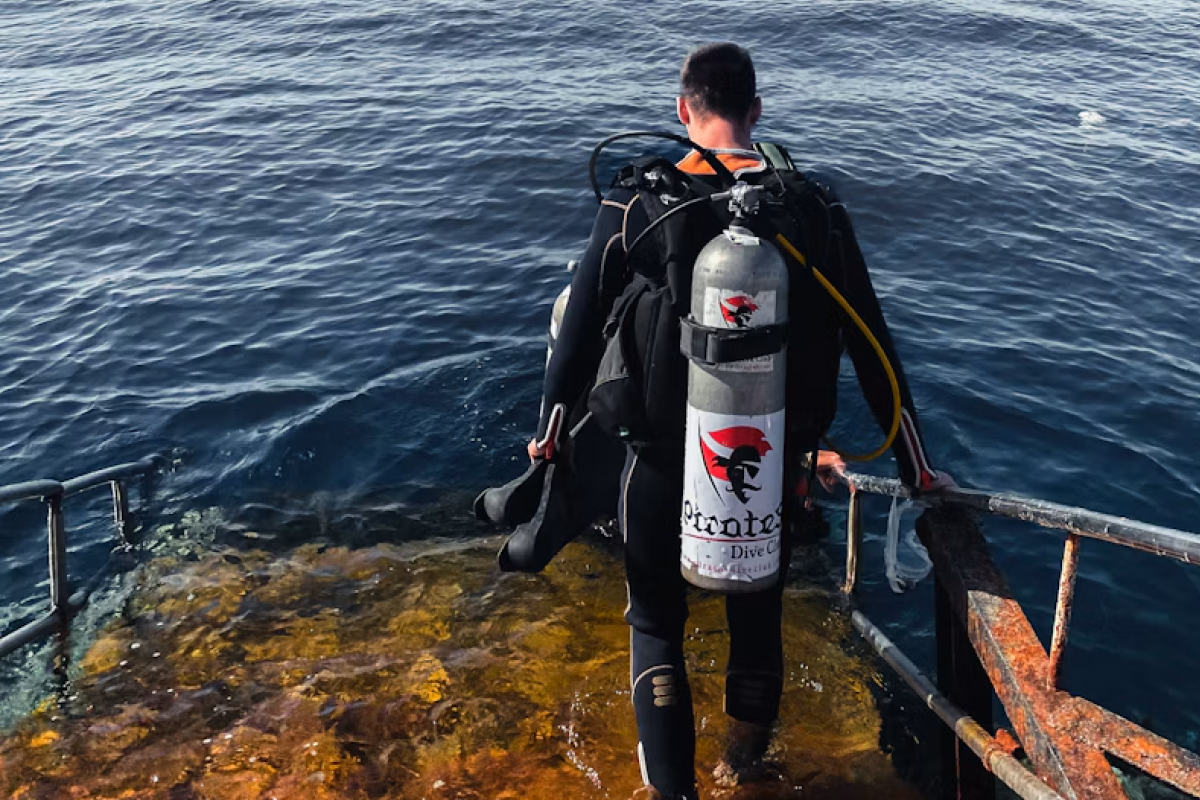
(Popovkin, 2022, Taken from Unsplash)
You spot a nudibranch, slow down and move a little closer. Your fins are clear of the coral and your hands are tucked in. Everything looks fine from where you are. Meanwhile, your pressure gauge is hanging below your BCD and brushing against the reef.
It is an easy detail to miss when your attention is somewhere else. A torch, spare regulator or camera tether can hang much lower underwater than you realised while gearing up on the boat. Before your next dive, it is worth taking a closer look at where everything sits.
Whether you are diving at Pulau Hantu or heading overseas for a weekend in Tioman, keeping your diving equipment close to your body helps protect the reef and your gear. It also makes your setup easier to manage. Here is how to tidy things up without making the equipment you need difficult to reach.
Your equipment needs as much clearance as your body
Keeping your hands and fins away from coral is only part of the picture. Anything attached to your BCD moves through the same environment, including the accessories you cannot easily see beneath you.
Loose equipment can scrape coral or catch on the reef as you swim past. Green Fins identifies dangling gear as a source of damage that divers may not even notice. A careful swimming position means little if a gauge is trailing well below it.
Think about the space occupied by your whole setup. Before approaching something interesting, leave room for your fins, cylinder and accessories as well as your face. If there is not enough clearance to hover comfortably without contact, enjoy the view from farther away.
Start by giving every item a proper place
Lay out the equipment you plan to carry and decide where each piece belongs. Your pressure gauge, alternate air source, torch, surface marker buoy and spool should all have an appropriate, repeatable storage position.
This makes it easier to notice when something is missing or has come loose. It also saves you from searching through several pockets every time you need one particular item. If you dive with different BCDs, check the layout again rather than assuming the attachment points will be in familiar places.
Our article on what is in a dive bag looks at useful accessories to bring along. Once you have decided what the dive requires, give each item somewhere secure to sit. Avoid filling every available D-ring simply because it is there, but keep the safety equipment required for your dive.
Secure your pressure gauge without making it awkward to read
A pressure gauge on a loose hose can swing beneath your body, particularly when you settle into a horizontal swimming position. It needs to stay close enough to avoid contact while remaining easy to retrieve and read.
Check the arrangement while wearing your full kit. Can you reach the gauge comfortably? Can you bring it into view without pulling another hose across your body? Can you return it to its position afterwards? A setup that only works when you are standing on the boat needs another look.
The Scubapro S-TEK Bolt Snap is one hardware option available at Dive Box, with different sizes to suit different handling needs. Choose an appropriate attachment method for your equipment and training. If the hose length or routing seems unsuitable, have the arrangement assessed instead of forcing the hose into a tight bend.
Keep your alternate air source accessible
Your spare regulator deserves particular attention. Leaving it dangling risks contact with the bottom, while burying it inside a pocket creates an entirely different problem.
For a conventional octopus setup, use an appropriate holder that keeps the second stage secure and allows it to be released promptly. Its position should be familiar to you and your buddy. Other regulator configurations have different procedures, so retain the arrangement you have been trained to use.
During the buddy check, show where your alternate air source is and how it releases. Check that a newly added pouch or accessory has not blocked access. The same applies to your inflator, BCD releases and weight-release system. Tidying up your diving equipment should preserve straightforward access to every essential control.
Use pockets for accessories that do not need to hang outside
A slate, spare mask or rolled surface marker buoy may fit neatly into a suitable pocket or pouch. Storing these items within your setup reduces the number of objects swinging around as you move.
Check that the pocket can close properly with its contents inside. An overfilled pocket is difficult to use, and loose contents can spill out when you open it to retrieve something else. Where your equipment provides an internal attachment point, use it appropriately to help retain items that could otherwise escape.
Spools also need secure storage so the line cannot unwind accidentally. Dive Box carries the Scubapro S-TEK Double-End Bolt Snap, with options described for spool and pocket attachment. Check that the clip suits the particular item and that you can operate it comfortably. Keep SMB deployment procedures consistent with your training; storage hardware is not a reason to attach a deploying line to yourself.
Check where your torch and camera go when you let go
A lanyard can stop an accessory from being lost, but it does not necessarily stop it from dragging. The important question is where the item ends up when it is no longer in your hand.
If your torch drops below your knees on a long tether, it still needs a suitable stowage position. The same applies to a camera hanging from a wrist strap. Before the dive, check the retained position of each accessory, including any slack in the tether.
Photography makes this especially relevant. It is easy to concentrate on the screen while overlooking the gauge below you or the torch hanging at your side. Pause before approaching your subject and check your position, surroundings and loose equipment. If holding the shot requires contact with the reef, move back and choose another angle.
Look at your setup in the position you actually dive in
Equipment can sit neatly against you on the surface and hang differently once you start swimming. Ask your buddy or instructor to look at your setup underwater in a suitable area with plenty of clearance.
Have them check beneath your torso and around your hips, where loose equipment may be difficult for you to see. A short video can be useful when conditions and the dive plan allow it. You may notice an accessory hanging lower than expected or a hose loop that was hidden during the surface check.
Pay attention after using equipment, too. A torch that starts the dive securely stowed can become the loose item you forget to put away. Return accessories to their proper places once you have finished with them.
Leave space for changes in buoyancy and position
Clips and pockets help organise equipment, but you still need clearance from the reef. Your position can change when you turn, stop to look at something or become distracted by a task.
Review your weighting and trim if you struggle to maintain a comfortable position. Carrying unnecessary weight can make buoyancy control more difficult. Work through adjustments with a qualified instructor rather than removing weight at random or trying unfamiliar changes above coral.
For Singapore divers, this applies just as much to local dives as it does to an overseas holiday. In reduced visibility, give yourself enough room to see what is ahead and beneath you. Avoid moving closer to the bottom simply to make it easier to follow the terrain.
Make a tidy setup part of every dive
Before entering the water, check that your accessories are secured, pocket closures are fastened and essential equipment remains accessible. Include your buddy in the check, then stay aware of anything that comes loose underwater.
After the dive, note what worked and what did not. Was a clip difficult to operate? Did a pocket open too easily? Did your camera hang lower than expected? Fixing one specific problem is more useful than adding several accessories without a clear purpose.
If you are reviewing your setup, speak with Dive Box about suitable attachment hardware for the equipment you own. Often, a few considered adjustments are enough to make your kit easier to manage and help you keep a comfortable distance from the reef.