
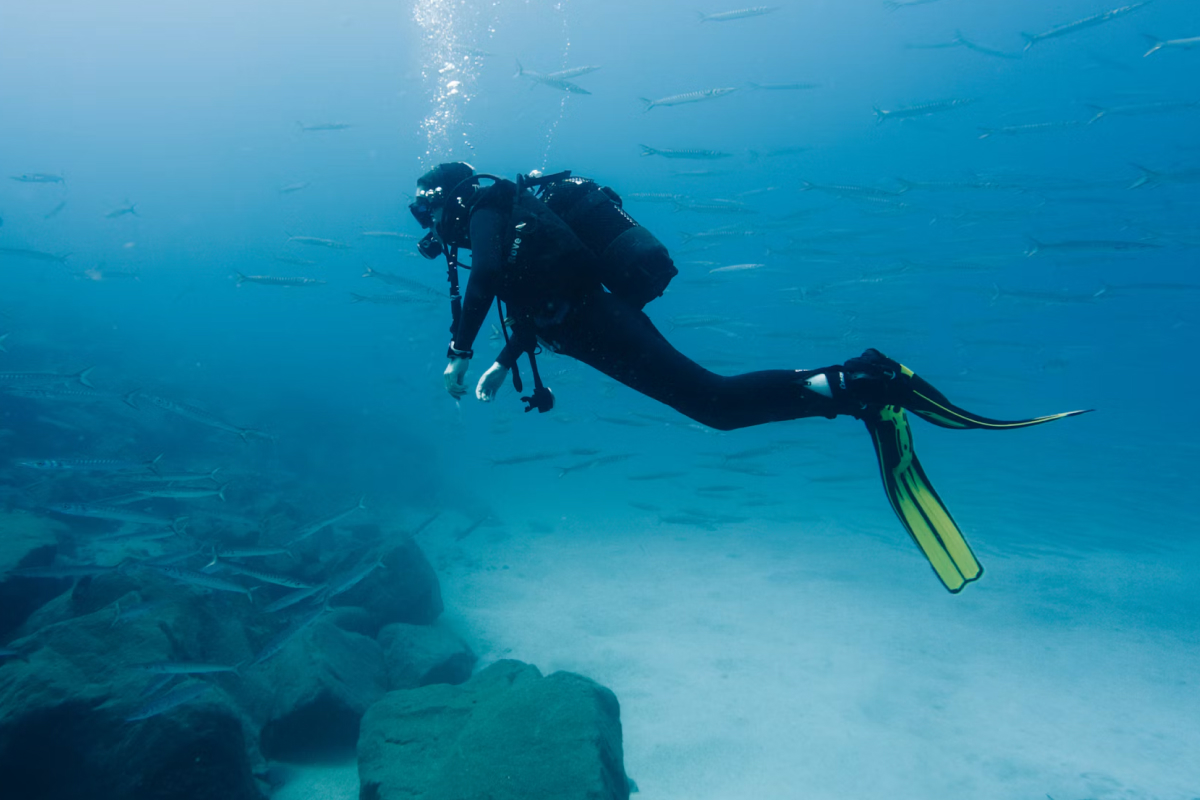
Source: Janesca, 2024 (via Unsplash)
The sun is out, the boat deck is hot and you are already sweating before putting on your BCD. A thicker wetsuit seems unnecessary. Then, halfway through the dive, you start wishing you had brought one.
For divers travelling from Singapore, this can be an unexpected part of a tropical diving holiday. The first few minutes feel comfortable, but by the safety stop you are thinking more about getting dry than the marine life you have just seen. On a day with several dives, the feeling can arrive even earlier each time.
Warm weather does not tell you how much thermal protection you need underwater. Dive duration, water temperature at depth and the fit of your diving wetsuit all matter. Understanding which part of your day is making you cold will help you make a more useful change to your equipment.
Tropical water can still take heat away from your body
Water that feels pleasant when you first jump in can still be cool enough for you to lose heat over time. It carries heat away much more effectively than air, which helps explain why a temperature that feels comfortable on land can become uncomfortable during a long immersion.
Your initial reaction is therefore only part of the story. A quick swim near the boat gives you very little information about how you will feel after a full dive. Divers Alert Network explains that prolonged immersion can lead to hypothermia even in tropical water. Feeling cold does not automatically mean you have hypothermia, but the setting alone cannot rule out a problem.
If you regularly finish dives chilled, treat that as information about your exposure protection and dive plan. You do not need to match the diver beside you who seems comfortable in a rash guard.
The water at the surface may be warmer than the dive site below
A tropical destination can have noticeable temperature changes underwater. A thermocline is a layer where temperature changes sharply with depth, and passing through one can make a comfortable descent suddenly feel much cooler.
Ask the dive operator about recent conditions at the sites you will actually visit. The useful question is what divers have been experiencing at the planned depths, rather than simply whether the destination is considered warm. Also ask whether cooler water is likely on particular dives during your trip.
Afterwards, note the temperature shown by your dive computer alongside how you felt and what you wore. Over several trips, that record becomes more useful than packing the same suit for every destination with a beach and palm trees.
Repeated dives can leave you starting the next dive already chilled
A wetsuit that feels adequate for one short dive may be less comfortable across a busy day of diving. If you have not warmed up properly between dives, the next immersion begins from a less comfortable starting point.
Think about the whole schedule. You might spend the first dive swimming steadily, the second hovering over a small subject with a camera, and the surface interval sitting in a wet suit while the boat moves to another site. Those are different conditions, even if the water temperature barely changes.
Tell your buddy and guide if you are getting cold. You can agree to shorten a dive or sit out a later one. Having enough gas left does not oblige you to stay underwater until everyone else is ready to finish.
A wetsuit that keeps flushing will struggle to keep you comfortable
A wetsuit allows some water inside, but its insulating material and close fit help slow heat loss. Repeatedly replacing the water beside your skin with cooler water makes that job harder.
Pay attention to cold water entering around your neck, wrists, ankles or zip. Notice whether it happens when you turn your head, reach forward or change position. Large gaps and loose folds can point to a mismatch between the suit's cut and your body.
When trying on a suit, check movement as well as the size label. You should be able to breathe fully, bend your knees and reach comfortably without excessive restriction. Going smaller simply to eliminate every wrinkle can create a different problem.
Our guide to choosing the right fit for fins, masks and wetsuits is a useful starting point when reviewing your setup. Bring details of your current suit and where it feels loose or restrictive when asking about alternatives.
Thickness matters alongside coverage and condition
A rash guard, a shorty and a full wetsuit offer different amounts of coverage and insulation. Ordinary thin rash guards should not be assumed to provide the same warmth as a neoprene wetsuit, even when both cover the arms.
For some tropical divers, a well-fitting 3mm full suit is a useful starting point. Others need more protection, particularly for longer or repeated dives. There is no single thickness that guarantees comfort for every diver at a given temperature.
Dive Box carries the GULL Black Edition 3mm Full Suit for men, with a women's version also listed in the range. Consider it as a fitting option and compare the cut against your needs. A product description cannot tell you whether a suit will seal comfortably around your own neck and limbs.
Check the condition of the suit you already own, too. Inspect its seams, zip and areas that have become damaged or noticeably thin. Neoprene also compresses at depth, reducing its insulation. A suit that feels adequate near the surface may be less comfortable farther down. Replace or repair equipment based on its condition and performance rather than assuming every wetsuit has the same replacement date.
A hood or thermal layer may help if the complete setup still fits
If your existing wetsuit fits well but you need more protection, an appropriate hood or additional thermal layer may be worth considering. The combination needs to work as a complete system, with enough room for comfortable breathing and movement.
The GULL 2 x 3mm FIR Hooded Vest for men and women's version are examples available from Dive Box. These are designed for colder conditions, so consider whether that level of extra protection suits the dives you have planned. Check how the vest fits with your suit and BCD rather than ordering from the size chart alone.
Extra neoprene can also change your buoyancy. Recheck weighting and buoyancy control when you change your exposure protection, following your training and getting instructor help if needed. Adding a layer and automatically keeping the same weights is not always appropriate.
What you wear between dives matters too
Wind across wet clothing can make a boat ride surprisingly cold. Evaporation and moving air continue to remove heat after you leave the water, particularly when you sit still in an exposed part of the boat.
Bring a dry towel and suitable dry clothing, with a wind-resistant outer layer when conditions call for it. Keep them somewhere they will stay dry. A warm layer buried beneath dripping equipment will be much less useful when you need it.
At the same time, avoid overheating on land. DAN advises against spending prolonged periods fully zipped into a wetsuit in hot conditions before entering the water. Time your gearing up sensibly and adjust your clothing to the conditions. The aim is to stay comfortably protected throughout the day.
Know when to end the dive
Do not wait for pronounced shivering before letting your buddy know that you are cold. Signal early and end the dive together using a controlled ascent and the procedures appropriate to your dive. Trying to warm yourself by swimming harder can add exertion and increase gas use without resolving inadequate protection.
Persistent shivering, clumsiness or difficulty thinking clearly need prompt attention. Once safely out of the water, tell the crew, get sheltered and replace wet clothing with dry insulation where practical. Confusion, unusual drowsiness or worsening symptoms require urgent medical assistance. Do not assume that feeling unwell after a dive is simply a temperature problem.
If you are not comfortably warm and well, skip the next dive. Another entry in the logbook is not worth carrying an unresolved problem back underwater.
Choose your next upgrade around the problem you actually have
Before buying a thicker suit, work out when the discomfort begins. Constant flushing suggests a fit issue. Getting cold late in a long dive may point towards insufficient insulation for that duration. Feeling chilled before you enter the water again means your surface routine also needs attention.
Take those observations to Dive Box when discussing wetsuits or additional layers. Mention your destinations, typical dive lengths and how many dives you usually do in a day. The better you can describe the problem, the easier it is to compare suitable equipment.
Comfortable tropical diving starts with choosing protection for the water and the way you dive. A little thought before packing can make the last dive of the trip much more enjoyable.