
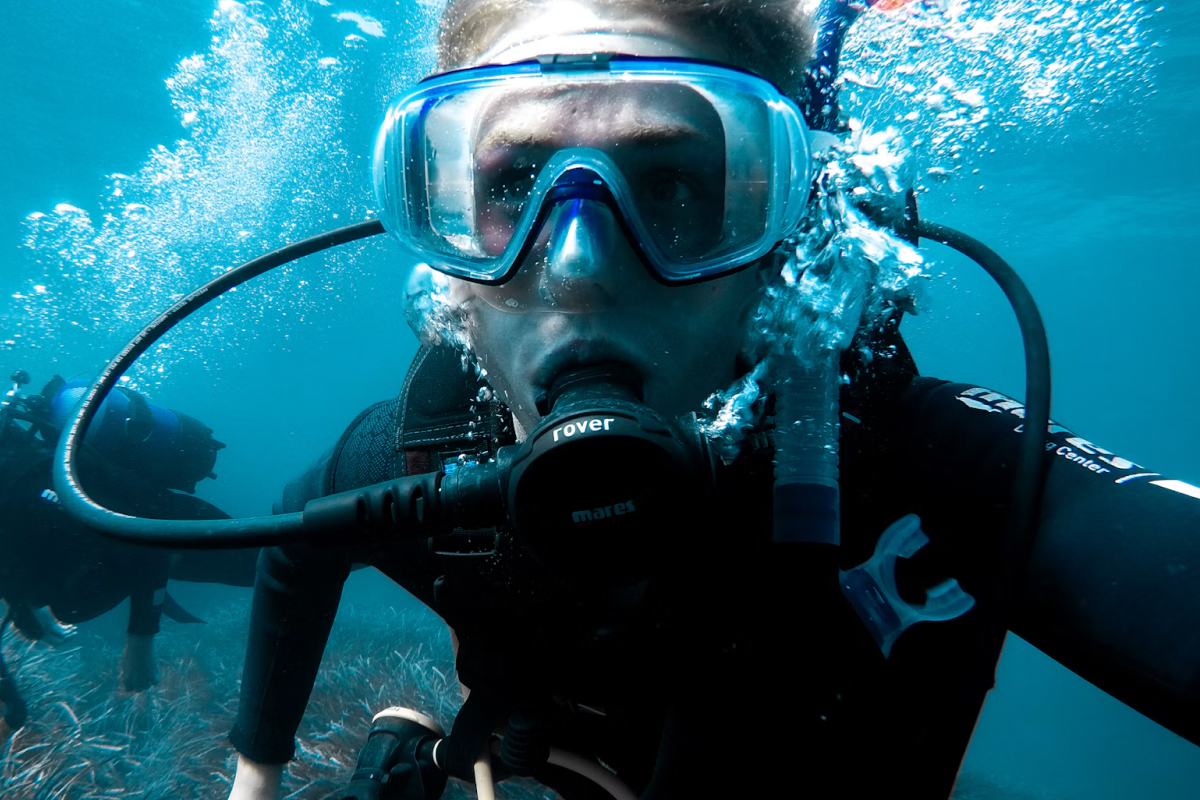
(van Vliet, 2020, via Unsplash)
A little water enters your mask, so you clear it. A few minutes later, it happens again. You tighten the strap, press the frame against your face and carry on, only to find another small pool forming beneath your eyes.
A leaking diving mask can become the most distracting piece of equipment you own. You spend the dive adjusting it instead of watching your buddy or enjoying the reef. It is tempting to decide that the mask is useless and buy another one straight away.
Sometimes a different mask is the answer. Often, though, the cause is something smaller: hair under the skirt, too much strap tension or a fit that changes when you put your regulator in your mouth. Before replacing it, work through the possible causes and notice when the water actually enters.
Check the seal before tightening the strap
The soft skirt around the mask is what seals against your face. The strap holds the mask in position, but pulling it tighter is not a reliable way to correct a poor fit.
If you have gradually tightened the strap over several dives, start again with a gentle adjustment on the surface. Settle the skirt evenly against your face and use enough tension to keep the mask comfortably positioned. Notice whether one side feels more compressed than the other or whether an edge has folded underneath itself.
A mask that needs to be painfully tight deserves further investigation. Look at how the skirt contacts your face rather than judging the fit by how firmly the frame can be pulled towards you.
Make small changes so you can tell which adjustment actually helps.
Keep hair and hood edges out of the skirt
A strand of hair across the sealing edge can leave a route for water to enter. This is particularly easy to miss around the forehead and temples when you put your mask on quickly or pull it down from the top of your head.
Move your hair clear before settling the mask into position. If you wear a hood, check that its edge has not slipped underneath the skirt. Ask your buddy to look at the parts you cannot see easily, especially around the sides of your face.
Repeat the check after moving your mask or adjusting your hood. A good seal at the start of the dive does not guarantee the skirt will stay perfectly seated after you have lifted it. Solving a small obstruction is much easier than repeatedly pulling on the strap without knowing why the mask is leaking.
Facial hair can affect the seal around your upper lip
A moustache can interrupt the contact between the skirt and the skin beneath your nose. The effect varies with the mask shape and the length and position of the hair, so two divers with similar facial hair may have different experiences.
If water consistently seems to enter near your upper lip, check where the skirt sits. PADI suggests trimming or shaving the small area where the mask needs to seal as one possible solution. Trying a different skirt shape may also help.
Avoid applying household grease or other products to the skirt without checking the manufacturer's guidance. Materials and care instructions differ. If you want to keep your moustache, explain that when trying masks so you can assess the fit as you actually intend to wear it.
Test the mask with your regulator mouthpiece
Your face changes shape when you hold a mouthpiece, smile or move your jaw. A mask can appear to fit well during a quick shop test and then behave differently once you are using your regulator.
PADI recommends checking mask fit with a regulator or snorkel mouthpiece where possible. Notice whether the skirt lifts around your cheeks or upper lip, and whether you are clenching your jaw to keep the mouthpiece comfortable. Do not force your face into an unnatural position simply to make the mask seal.
Think back to when the leak happens. Does it begin when you smile for a photograph, turn to look at your buddy or move the regulator in your mouth? That pattern is useful information. It gives you something specific to check before concluding that the entire mask needs replacing.
Look for anything that pulls the mask out of position
A twisted strap or uneven adjustment can make the mask sit awkwardly. Check that the strap lies flat and that the buckles hold the setting properly. An attached snorkel should not pull heavily on one side of the frame or interfere with adjustment.
If your strap is damaged or keeps slipping, a compatible replacement may solve the problem without buying a new mask. Dive Box stocks the Scubapro Velcro Mask Strap, alongside other mask accessories. Confirm compatibility with your particular mask before ordering.
A more comfortable strap can make the mask easier to position, but it will not change the shape of the silicone skirt. Separate a strap problem from a fit problem so that you replace the part that is actually causing trouble.
Inspect an older mask for damage and trapped debris
If a mask that used to work well has started leaking, inspect it carefully after rinsing. Look for sand or other debris around the skirt and check for visible tears, distorted edges or damaged strap attachments. If your model has a purge valve, inspect that according to its instructions as well.
Think about any recent changes. Has the mask been packed under heavy equipment? Has the strap been replaced? Have the lenses been changed? If leakage started immediately after lens replacement or other work, have the assembly checked before the next dive.
Follow the manufacturer's cleaning and storage guidance. Avoid improvised repairs to the lens or frame, and retire a mask with damaged glass. Keeping a mask in a protective case also reduces the chance of it being crushed in transit.
Make sure you are solving a leak rather than fogging
Fogging and leakage can both make a dive uncomfortable, but they have different causes. Condensation creates a film on the lens; a leak lets water enter through the seal or another opening.
If the view becomes cloudy without a growing pool of water, review your lens preparation and defog routine. If water collects and needs repeated clearing, inspect the fit and condition of the mask. Defog solution cannot repair a leaking seal.
This distinction matters because it stops you changing several things at once. Identify the symptom first, then make an appropriate adjustment. Follow the instructions for your lens type, especially if it has an optical insert, coating or anti-fog film.
Keep equalising your mask during descent
A mask that starts to press against your face as you descend needs attention to equalisation. The air space inside it must be equalised by gently adding air through your nose, as you were taught during training.
DAN explains that failing to equalise this space can cause mask squeeze, with bruising and other injury. Do not try to prevent leaks by avoiding nasal exhalation altogether, and do not tighten the strap to deal with pressure-related discomfort.
If you cannot manage the mask comfortably, signal your buddy and follow your training. Eye pain or changes in vision after a dive warrant medical attention. Repeated difficulty clearing or equalising is a good reason to practise with a qualified instructor in a controlled setting.
Try a different shape if the fit is consistently wrong
After checking the strap, sealing edge and condition, you may find that the mask simply does not suit your face. Price and popularity do not guarantee a comfortable seal for every diver.
When comparing alternatives, use the gentle dry-fit check: place the mask against your face with the strap out of the way and inhale lightly through your nose. It should hold without continuous strong suction. Then assess pressure points, nose access and how it feels with a mouthpiece. The dry test helps narrow the choices, but it cannot promise a leak-free dive.
The Scubapro Solo is one single-lens option available at Dive Box, with a silicone skirt and adjustable buckles. Treat it as a model to compare for fit, rather than a universal solution to leakage. Our guide to fins, masks and wetsuit fit provides more context when assessing your equipment.
Make the next dive a check of one useful change
Try to establish what has improved before changing everything else. Clearing hair from the skirt, resetting strap tension or choosing a better-fitting mask are separate adjustments, and knowing which one worked will save you time later.
Keep mask-clearing skills current even with a well-fitting mask. Occasional water entry can still happen, and being comfortable managing it makes a small interruption easier to handle. If repeated flooding becomes distracting or stressful, signal your buddy and end the dive safely rather than spending it struggling with your equipment.
If you are unsure whether you need a new strap or a different mask, bring your current model when discussing equipment with Dive Box. Explain when it leaks and what you have already tried. A useful fitting conversation starts with those details, and may lead to a much simpler fix than you expected.